The Smoking Yard is reader supported. When you buy through links on our site, we may earn an affiliate commission. As an Amazon Associate, we earn from qualifying purchases.
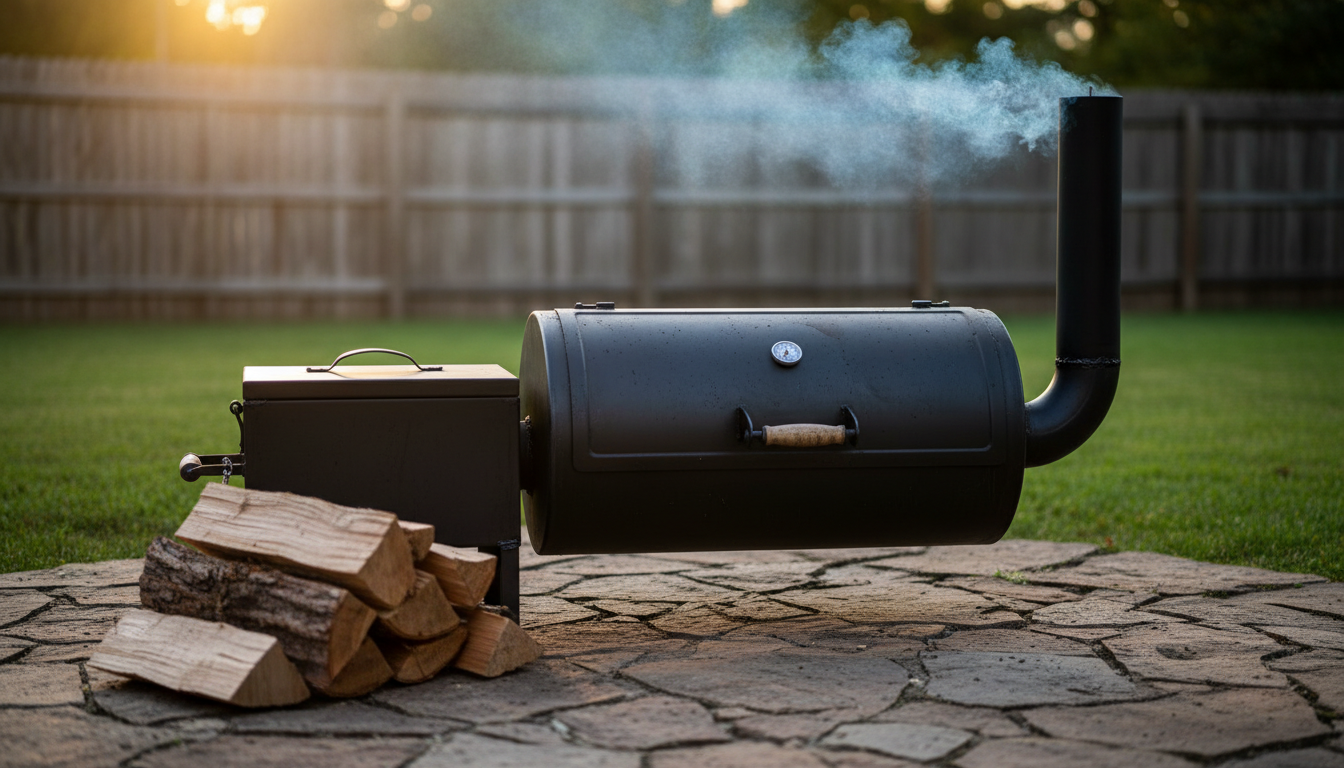
An offset smoker is the classic Texas barbecue cooker: a long horizontal cook chamber with a firebox bolted to one end. You burn wood or charcoal in the firebox, and the heat and smoke travel sideways across your meat and out the chimney.
The catch is that an offset needs your attention. A thin, leaky offset can turn a 12 hour brisket into a 12 hour wrestling match. The best offset smoker for you depends on how much you want to spend, how much you cook, and how much tinkering you will tolerate.
Below, we compare eight offset smokers that are on sale in 2026, from a $200 starter grill to a quarter-inch steel pit that will outlast your mortgage. We pulled every spec from manufacturer pages and major retailers, and we lean on what owners report.
Quick Answer: For most beginners, the Oklahoma Joe’s Highland offers the best mix of price, size, and parts support. On a tight budget, the Char-Griller Smokin’ Pro gets you smoking for around $300. If you can spend more, the Oklahoma Joe’s Longhorn Reverse Flow evens out hot spots, and the Old Country BBQ Pits Brazos is the most affordable quarter-inch steel offset we found.
Offset Smoker Comparison Table
| Product | Best For | Key Specs | Approx. Price | Link |
|---|---|---|---|---|
| Royal Gourmet CC1830 Charcoal Grill with Offset Smoker | Tight budgets and first smokes | About 823 square inches total (475 main), thin steel, small side firebox | Around $160 to $200 | Check price on Amazon |
| Char-Griller Smokin’ Pro Barrel Grill and Offset Smoker | Grilling and smoking on one cooker | 1,130 square inches total (580 main), side firebox, 103 pounds | Around $300 | Check price on Amazon |
| Dyna-Glo Signature Series Vertical Offset Smoker (DGSS1382VCS-D) | Big capacity in a small footprint | 1,382 square inches across 5 grates, vertical cabinet | Around $350 | Check price on Amazon |
| Oklahoma Joe’s Highland Offset Smoker | Best overall for most beginners | 879 square inches (616 main, 263 firebox grate), about 156 pounds | Around $430 to $500 | Check price on Amazon |
| Oklahoma Joe’s Longhorn Reverse Flow Offset Smoker | More even heat and bigger cooks | 1,060 square inches (751 main, 309 secondary), 4 baffles, about 2.5 millimeter steel | Around $730 to $900 | Check price on Amazon |
| Old Country BBQ Pits Pecos Offset Smoker | Heavier steel without a $2,000 bill | About 900 square inches, 14 gauge body, 11 gauge doors, 16.5 by 16.5 inch firebox | Around $850 | Check price on Amazon |
| Old Country BBQ Pits Brazos Offset Smoker | Quarter-inch steel at a fair price | 901 square inches (621 main, 280 secondary), 1/4 inch steel, about 429 pounds | Around $2,000 | Check price on Amazon |
| Yoder Smokers Loaded Wichita Offset Smoker | Serious hobbyists who want a lifetime pit | 1,610 square inches with second shelf, 1/4 inch steel, about 800 pounds | Around $2,900 | Check price on Amazon |
Prices change often and vary by retailer, so treat these as ballpark figures and check the current price before you buy.
How We Chose
We did not cook on these smokers ourselves. Instead, we built this list from published specifications, retailer listings, and long-running owner discussions on barbecue forums and review sites. We weighed five things:
- Current availability: every model on this list was listed for sale by the manufacturer or a major US retailer in late 2026. We skipped models showing as out of stock at the manufacturer, such as the Char-Griller Grand Champ and Competition Pro, although you may still find them at some stores.
- Steel thickness: where the maker or retailer publishes it. Thicker steel holds heat better and resists wind and cold.
- Cooking area and firebox size: enough room for a full packer brisket or several pork butts, and a firebox big enough to burn real wood splits.
- Owner reports: how often owners mention leaks, temperature swings, and rust, and how easy the common fixes are.
- Value per tier: we picked the strongest options under $500, from $500 to $1,000, and above $1,000.
The Best Offset Smokers by Budget
Under $500
Royal Gourmet CC1830 Charcoal Grill with Offset Smoker
The Royal Gourmet CC1830 is a barrel charcoal grill with a small offset firebox on the side. Royal Gourmet lists about 823 square inches in total: 475 square inches of main grates, a 151 square inch warming rack, and 197 square inches in the side box. The charcoal pan in the main chamber adjusts to two heights, so you can grill directly or run the side box as a smoker.
What we like: It costs less than a lot of smoker accessories, and it doubles as a regular charcoal grill for burgers and steaks.
Watch out for: The steel is thin and the firebox is small, so it loses heat fast in wind or cold weather. Owners of grills in this class commonly report smoke leaking from the lid and firebox joints. Plan on charcoal with a few wood chunks rather than full wood splits.
Best for: Curious beginners who want to try low and slow cooking before spending real money.
Char-Griller Smokin’ Pro Barrel Grill and Offset Smoker
Char-Griller’s Smokin’ Pro (model CG30044223) is a step up in size and sturdiness. Char-Griller lists 1,130 square inches of total cooking space, with 580 square inches on the primary grates, and a side firebox that bolts to the barrel. The whole unit weighs about 103 pounds, according to the manufacturer.
What we like: A big grilling surface, a long track record, and an easy upgrade path with gaskets and simple mods.
Watch out for: Like most budget barrels, it uses thin steel, so it struggles to hold steady temperatures on cold or windy days. Expect to add high-temperature gasket tape around the lid and firebox. The firebox fits charcoal and wood chunks better than large splits.
Best for: Backyard cooks who grill most nights and smoke a few times a month.
Dyna-Glo Signature Series Vertical Offset Smoker (DGSS1382VCS-D)
The Dyna-Glo Signature Series DGSS1382VCS-D flips the usual layout. Instead of a long horizontal barrel, it stacks five chrome-plated grates in a tall cabinet with the firebox mounted low on the side. Retailers list 1,382 square inches of total cooking area, plus sausage hooks.
Because heat and smoke rise straight up, a vertical offset tends to cook more evenly from left to right than a cheap horizontal barrel. AmazingRibs makes that point in its review of Dyna-Glo’s vertical offset, while also flagging the lightweight steel.
What we like: Huge capacity for ribs, sausage, jerky, and fish in a small patio footprint, at a budget price.
Watch out for: Thin steel and a small firebox mean frequent refueling, and owners often add door gaskets to stop smoke leaks. You also cannot grill on it the way you can on a barrel.
Best for: Cooks who want maximum rack space for ribs and sausage and do not need a grill.
Oklahoma Joe’s Highland Offset Smoker
Oklahoma Joe’s lists a 616 square inch main grate and a 263 square inch firebox grate, for 879 square inches you can actually cook on. The current Highland DLX (model 24203002) weighs about 156 pounds and comes with a two year warranty, according to the manufacturer.
Oklahoma Joe’s describes it as heavy-gauge steel but does not publish a number. A Tractor Supply support answer on the Longhorn says the brand’s offsets use about 2.5 millimeter steel, which is noticeably sturdier than most barrels in this price range.
What we like: Wide availability at big box stores, real parts support, and a huge community of owners who have already figured out the common fixes.
Watch out for: Owners frequently report smoke leaking around the lid and firebox, and many add gasket tape, a heat deflector, or a chimney extension. The main chamber also runs hotter on the firebox side unless you add a baffle or rotate your meat.
Best for: Most beginners who want a real offset smoker for less than $500.
$500 to $1,000
Oklahoma Joe’s Longhorn Reverse Flow Offset Smoker
The Longhorn Reverse Flow is the Highland’s bigger sibling with a smarter airflow design. Tractor Supply lists 751 square inches of primary space and 309 square inches of secondary space, for 1,060 square inches in total. Four baffles under the grates force heat to travel to the far end of the chamber and then back over the meat before it exits. You can also move the smokestack to run it as a traditional offset.
Retailer support answers put the steel at about 2.5 millimeters, roughly 12 to 13 gauge.
What we like: Reverse flow evens out the hot spot near the firebox, so you spend less time rotating meat. The extra space fits a full packer brisket with room to spare.
Watch out for: It still uses mass-market seals, so owners report some leaking around doors. It is big and heavy, so measure your patio and plan for a two person assembly.
Best for: Cooks feeding big families or crowds who want more consistent heat without paying for quarter-inch steel.
Old Country BBQ Pits Pecos Offset Smoker
Old Country BBQ Pits sells its smokers through Academy Sports, Tractor Supply, and specialty barbecue shops. The Pecos uses a 14 gauge steel body with 11 gauge doors, according to a restaurant supply retailer’s spec sheet, and offers about 900 square inches of cooking space with a 17.5 by 36 inch main grate. The firebox measures 16.5 by 16.5 inches, large enough for real wood splits.
What we like: Heavier steel and a roomier firebox than most mass-market offsets at a mid-range price.
Watch out for: Shipping weight runs around 360 pounds, so you will need help moving it. Availability varies by region, and Amazon stock may be limited, so check local stores too.
Best for: Buyers ready to burn mostly wood who want a sturdier pit without a $2,000 price.
$1,000 and Up
Old Country BBQ Pits Brazos Offset Smoker
The Brazos is the pit many barbecue forums recommend when someone asks for the cheapest way into quarter-inch steel. BBQGuys lists it with 1/4 inch, all-welded steel, a 621 square inch main grate, and a 280 square inch upper rack, for 901 square inches in total. It weighs about 429 pounds.
What we like: Thick steel holds heat through wind and cold, and the welded build means far fewer leaks than budget offsets.
Watch out for: It costs around $2,000 and weighs over 400 pounds. Fit and finish are good for the money but not at the level of premium American pits, and owners sometimes touch up paint or add gaskets.
Best for: Committed backyard cooks who want true stick burner performance without custom pit pricing.
Yoder Smokers Loaded Wichita Offset Smoker
Yoder Smokers builds the Loaded Wichita in Kansas from 1/4 inch steel. According to All Things Barbecue, the Loaded version adds a slide-out second shelf, a counterweighted lid, and a heat management plate, for 1,610 square inches of total cooking space. It weighs about 800 pounds and, at the time of writing, shipped in 12 to 14 weeks.
What we like: Heirloom build quality, excellent heat retention, and enough space for multiple briskets.
Watch out for: The price and weight are serious, and lead times can stretch to months. It is often sold through specialty dealers rather than Amazon.
Best for: Experienced cooks or anyone who wants to buy one offset and never shop again.
Offset Smoker Buying Guide
Steel Thickness
Steel thickness matters more on an offset than on almost any other cooker. Thick steel stores heat, which smooths out the temperature spikes and dips that happen every time you add fuel. Gauge numbers run backward: a lower number means thicker steel. For reference, 14 gauge is about 1.9 millimeters, 12 gauge is about 2.7 millimeters, and 1/4 inch plate is about 6.4 millimeters.
Most smokers under $1,000 use roughly 14 to 12 gauge steel, and many makers simply say heavy gauge without a number.
Airflow and Design
A traditional offset sends heat straight across the chamber, so the end near the firebox runs hottest. A reverse flow design adds a plate or baffles that push heat to the far end first, then back toward a chimney on the firebox side. That evens out temperatures at the cost of a little extra warm-up time.
Look for a chimney that draws from grate level, an intake damper that closes fully, and a firebox big enough to hold a small fire of wood splits.
Leaks and Common Mods
Almost every offset under $1,000 leaks smoke somewhere, usually at the lid, the firebox door, and the joint between firebox and chamber. A little leaking is normal. Big leaks pull in extra air, which makes temperatures hard to control. Owners commonly make these fixes:
- High-temperature gasket tape or rope gasket around the lid and firebox door.
- Food-safe high-temperature sealant on the bolted firebox joint.
- A chimney extension that brings the stack opening down to grate level.
- A baffle or tuning plates to spread heat away from the firebox side.
- A charcoal basket in the firebox so the fire gets air from below.
Fuel Management for Beginners
The goal on an offset is a small, hot, clean fire, not a big smoldering one. Thick white smoke usually means the fire is starved for air and will make food taste bitter. Thin, nearly invisible blue smoke means a clean burn. A simple routine works for most beginners:
- Start with a full chimney of lit charcoal in the firebox to build a bed of coals.
- Add one or two seasoned hardwood splits or chunks at a time, preheating them on top of the firebox if you can.
- Keep the chimney damper fully open and adjust heat mainly with the firebox intake.
- Add a new split when the last one has burned down to coals, usually every 30 to 60 minutes on smaller pits.
- Use a good digital thermometer at grate level, because lid thermometers often read differently.
Thin budget smokers burn through fuel faster and need more frequent feeding, especially in cold weather.
Cooking Area and Footprint
For a family, 600 to 800 square inches of main grate space handles a full packer brisket or two pork butts. If you cook for crowds, look at the Longhorn class or larger.
Related Guides
Frequently Asked Questions
Is an offset smoker good for beginners?
Yes, if you enjoy learning by doing. Offsets need more attention than pellet grills, but a mid-weight model like the Oklahoma Joe’s Highland, plus a few sealing mods, gives beginners a manageable way to learn fire control.
What steel thickness should an offset smoker have?
Quarter-inch steel is the gold standard for heat retention. For budget and mid-range smokers, 12 gauge (about 2.7 millimeters) is a solid target. Thinner steel works, but it needs more fuel and more attention in cold or windy weather.
Can I use charcoal in an offset smoker?
Yes. Many owners of thinner smokers run a charcoal base and add wood chunks or splits for flavor.
Why does my offset smoker run hotter on one side?
Heat enters from the firebox end, so that side gets hotter. A baffle, tuning plates, a reverse flow design, or simply rotating your meat partway through the cook will even things out.
What temperature should meat reach in a smoker?
Follow the United States Department of Agriculture (USDA) safe minimum internal temperatures: 145 degrees Fahrenheit (°F) with a 3 minute rest for whole cuts of beef and pork, 160°F for ground meats, and 165°F for poultry.
Are cheap offset smokers worth it?
They can be, as long as you expect to do some tinkering. A $300 smoker with $30 of gasket tape and a chimney extension can turn out great food. If you hate fiddling, save up for something in the $700 and up range.
Final Verdict
For most people shopping for their first stick burner, the Oklahoma Joe’s Highland is the safest bet: it is sold everywhere, it is big enough for a brisket, and thousands of owners have already documented every fix. If you want to spend as little as possible, the Char-Griller Smokin’ Pro gets you started for around $300, and the Royal Gourmet CC1830 costs even less.
Step up to the Oklahoma Joe’s Longhorn Reverse Flow for more even heat and space, or the Old Country Pecos for heavier steel at a mid-range price. If you are ready to commit, the quarter-inch Old Country Brazos and Yoder Loaded Wichita hold heat like nothing else on this list.
Leave a Reply